Make a plan for managing your corporation: Corporate Bylaws
What we’ll cover
What are Corporate Bylaws?
Corporate Bylaws define a corporation's purpose, how it will operate, and detail the duties of the people who manage it. Bylaws also allow you to define shareholder ownership rights, select officers and directors, plan annual meetings, establish how to remove officers or directors, and define how the corporation will issue stock.
While Articles of Incorporation define the basic structure of a corporation, Corporate Bylaws further outline how the corporation will operate. They can contain any provisions not inconsistent with state law or the Articles, relating to the business of the corporation, the conduct of its affairs, and the rights and powers of the shareholders, directors, officers, and employees.
It's a good idea to create Corporate Bylaws even if your state does not require them, because they clearly articulate how the business operates and ensure that everyone is on the same page. Make your own with Rocket Lawyer now – it's as easy as answering a few questions.
When to use Corporate Bylaws:
- You want to define the structure of a newly incorporated small business or non-profit organization.
- You want to detail a corporation's purpose, operations, and the duties of the people who manage it.
Have questions about your Corporate Bylaws?
Whether you're preparing your Corporate Bylaws, reviewing one someone sent you, or just want to understand it better, here's how to get help.
- Understand what it says or review it. Use our AI legal assistant to ask questions about your Corporate Bylaws, understand what it says, and spot anything that may need a closer look.
- Ask an attorney a question. Connect with an attorney for legal information, with a written answer within one business day or a live consultation.
- Get advice on what to do. For privileged, confidential advice about your specific circumstances and next steps, book a Legal Advice Session with an attorney.
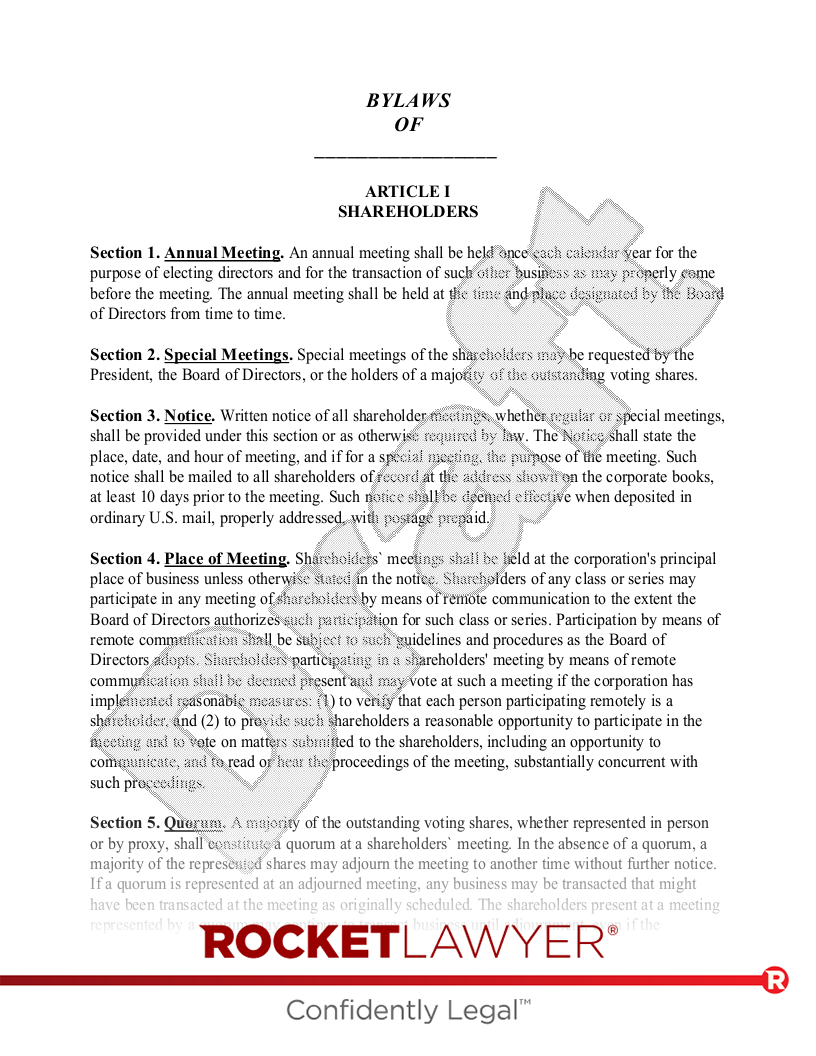
Sample Corporate Bylaws
The terms in your document will update based on the information you provide
 This document has been customized over 417.5K times
 Legally binding and enforceable
 Consult an Attorney to ask questions or review your document
 Sign this document online for free with RocketSign®
 Complies with relevant laws
BYLAWS
OF
The name of the organization is . The organization is organized in accordance with the Alabama Nonprofit Corporation Act, Alaska Nonprofit Corporation Act, Arizona Nonprofit Corporation Act, Arkansas Nonprofit Corporation Act of 1993, Nonprofit Corporation Act of California, Colorado Revised Nonprofit Corporation Act, Connecticut Revised Nonstock Corporation Act, Delaware General Corporation Law, D.C. Nonprofit Corporation Act of 2010, Florida Not For Profit Corporation Act, Georgia Nonprofit Corporation Code, Hawaii Nonprofit Corporations Act, Idaho Nonprofit Corporation Act, General Not For Profit Corporation Act of 1986, Indiana Nonprofit Corporation Act of 1991, Revised Iowa Nonprofit Corporation Act, Kansas Code, Chapter 17, Kentucky Revised Statutes, Title XXIII, Chapter 273, Louisiana Revised Statutes, Chapter 2, Title 12, Maine Nonprofit Corporation Act, Corporations and Associations Article of the Annotated Code of Maryland, General Law of the Commonwealth of Massachusetts, Title XXII, Chapter 180, Nonprofit Corporation Act, Act 162 of 1982, Minnesota Statutes, Chapter 317A, Corporations, Associations and Partnerships Section of the Mississippi Code, Title 79, Chapter 11, Nonprofit Corporation Law of Missouri, Montana Code Annotated, Title 35, Chapter 2, Nebraska Revised Statutes, Chapter 21, Revised Nevada Statutes, Chapter 82, New Hampshire Revised Statutes, Chapter 292, New Jersey Statutes, Title 15 A, Nonprofit Corporation Act, New York Non Profit Corporation Act, North Carolina Nonprofit Corporation Act, North Dakota Nonprofit Corporations Act, Nonprofit Corporation Law, Oklahoma Statutes, Title 18, Corporations, Oregon Nonprofit Corporation Act, Pennsylvania Code, Chapter 41, Rhode Island Nonprofit Corporation Act, South Carolina Nonprofit Corporation Act, South Dakota Nonprofit Corporation Act, Tennessee Code Annotated, Title 48, Texas Civil Statutes, Chapter 9, Utah Revised Nonprofit Corporation Act, Vermont Statutes, Title 11B, Virginia Nonstock Corporation Act, Washington Nonprofit Corporation Act, West Virginia Nonprofit Corporation Act, Wisconsin Annotated Code, Chapter 181, Wyoming Nonprofit Corporation Act, as amended. The organization has not been formed for the making of any profit, or personal financial gain. The assets and income of the organization shall not be distributable to, or benefit the trustees, directors, or officers or other individuals. The assets and income shall only be used to promote corporate purposes as described below. Nothing contained herein, however, shall be deemed to prohibit the payment of reasonable compensation to employees and independent contractors for services provided for the benefit of the organization. This organization shall not carry on any other activities not permitted to be carried on by an organization exempt from federal income tax. The organization shall not endorse, contribute to, work for, or otherwise support (or oppose) a candidate for public office. The purpose of the organization is the following:
The organization is organized exclusively for purposes pursuant to section 501(c)(3) of the Internal Revenue Code.
ARTICLE
SHAREHOLDERSMEETINGS
Section . Annual Meeting. An annual meeting shall be held once each calendar year for the purpose of electing directors and for the transaction of such other business as may properly come before the meeting. The annual meeting shall be held at the time and place designated by the Board of Directors from time to time.
Section . Special Meetings. Special meetings of the shareholders may be requested by the President or the Board of Directors., the Board of Directors, or the holders of a majority of the outstanding voting shares.
Section . Notice. Written notice of all shareholder meetings, whether regular or special meetings, shall be provided under this section or as otherwise required by law. The Notice shall state the place, date, and hour of meeting, and if for a special meeting, the purpose of the meeting. Such notice shall be mailed to all of record at the address shown on the corporate books, at least 10 days prior to the meeting, or 20 days if removing a director, or 20 days if a merger vote is to be taken, but no more than 60 days in advance of a meeting. Such notice shall be deemed effective when deposited in ordinary U.S. mail, properly addressed, with postage prepaid.
Section . Place of Meeting. Shareholders` meetings Meetings shall be held at the corporationorganization's principal place of business unless otherwise stated in the notice. Shareholders of any class or series may participate in any meeting of shareholders by means of remote communication to the extent the Board of Directors authorizes such participation for such class or series. Participation by means of remote communication shall be subject to such guidelines and procedures as the Board of Directors adopts. Shareholders participating in a shareholders' meeting by means of remote communication shall be deemed present and may vote at such a meeting if the corporation has implemented reasonable measures: (1) to verify that each person participating remotely is a shareholder, and (2) to provide such shareholders a reasonable opportunity to participate in the meeting and to vote on matters submitted to the shareholders, including an opportunity to communicate, and to read or hear the proceedings of the meeting, substantially concurrent with such proceedings.
Section . Quorum. A majority of the directors outstanding voting shares, whether represented in person or by proxy, shall constitute a quorum at a shareholders` meeting. In the absence of a quorum, a majority of the directors represented shares may adjourn the meeting to another time without further notice. If a quorum is represented at an adjourned meeting, any business may be transacted that might have been transacted at the meeting as originally scheduled. The present at a meeting represented by a quorum may continue to transact business until adjournment, even if the withdrawal of some results in representation of less than a quorum.
ARTICLE
DIRECTORS
Section . Number of Directors. The corporation organization shall be managed by a Board of Directors consisting of director(s).
Section . Election and Term of Office. The directors shall be elected at the annual shareholders` meeting. Each director shall serve a term of year(s), or until a successor has been elected and qualified.
Section . Quorum. A majority of directors shall constitute a quorum.
Section . Adverse Interest. In the determination of a quorum of the directors, or in voting, the disclosed adverse interest of a director shall not disqualify the director or invalidate his or her vote.
Section . Regular Meeting. An annual meeting shall be held, without notice, immediately following and at the same place as the annual meeting of the shareholders. The Board of Directors shall meet immediately after the election for the purpose of electing its new officers, appointing new committee chairpersons and for transacting such other business as may be deemed appropriate. The Board of Directors may provide, by resolution, for additional regular meetings without notice other than the notice provided by the resolution.
Section . Special Meeting. Special meetings may be requested by the President, Vice-President, Secretary, or any two directors by providing five days' written notice by ordinary United States mail, effective when mailed. Minutes of the meeting shall be sent to the Board of Directors within two weeks after the meeting.
Section . Procedures. The vote of a majority of the directors present at a properly called meeting at which a quorum is present shall be the act of the Board of Directors, unless the vote of a greater number is required by law or by these by-laws for a particular resolution. A director of the corporation organization who is present at a meeting of the Board of Directors at which action on any corporate matter is taken shall be presumed to have assented to the action taken unless their dissent shall be entered in the minutes of the meeting. The Board shall keep written minutes of its proceedings in its permanent records.
If authorized by the governing body, any requirement of a written ballot shall be satisfied by a ballot submitted by electronic transmission, provided that any such electronic transmission must either set forth or be submitted with information from which it can be determined that the electronic transmission was authorized by the member or proxy holder.
Section . Removal / Vacancies. A director shall be subject to removal, with or without cause, at a meeting of the shareholders called for that purpose. Any vacancy that occurs on the Board of Directors, whether by death, resignation, removal or any other cause, may be filled by the remaining directors. A director elected to fill a vacancy shall serve the remaining term of his or her predecessor, or until a successor has been elected and qualified.
Section . Resignation. Any director may resign effective upon giving written notice to the chairperson of the board, the president, the secretary or the Board of Directors of the corporation, unless the notice specifies a later time for the effectiveness of such resignation. If the resignation is effective at a future time, a successor may be elected to take office when the resignation becomes effective.
Section . Committees. To the extent permitted by law, the Board of Directors may appoint from its members a committee or committees, temporary or permanent, and designate the duties, powers and authorities of such committees.
ARTICLE
OFFICERS
Section . Number of Officers. The officers of the corporation organization shall be a President, one or more Vice-Presidents (as determined by the Board of Directors), a Treasurer, and a Secretary.Two or more offices may be held by one person, although the offices of Secretary and President cannot be held concurrently by the same person. The President/Chairman may not concurrently serve as the Secretary or Treasurer/CFO. The President may not serve concurrently as a Vice President.
President/Chairman. The President shall be the chief executive officer and shall preside at all meetings of the Board of Directors and its Executive Committee, if such a committee is created by the Board.
Secretary. The Secretary shall give notice of all meetings of the Board of Directors and Executive Committee, if any, shall keep an accurate list of the directors, and shall have the authority to certify any records, or copies of records, as the official records of the . The Secretary shall maintain the minutes of the Board of Directors' meetings and all committee meetings.
Section . Election and Term of Office. The officers shall be elected annually by the Board of Directors at the first meeting of the Board of Directors, immediately following the annual meeting of the shareholders. Each officer shall serve a one year term or until a successor has been elected and qualified.
Section . Removal or Vacancy. The Board of Directors shall have the power to remove an officer or agent of the . Any vacancy that occurs for any reason may be filled by the Board of Directors.
ARTICLE
CORPORATE SEAL, EXECUTION OF INSTRUMENTS
The corporation organization shall have a corporate seal, which shall be affixed to all deeds, mortgages, and other instruments affecting or relating to real estate. shall not have a corporate seal. All instruments that are executed on behalf of the corporation organization which are acknowledged and which affect an interest in real estate shall be executed by the President or any Vice-President and the Secretary or Treasurer. All other instruments executed by the corporationorganization, including a release of mortgage or lien, may be executed by the President or any Vice-President. Notwithstanding the preceding provisions of this section, any written instrument may be executed by any officer(s) or agent(s) that are specifically designated by resolution of the Board of Directors.
ARTICLE
AMENDMENT TO BYLAWS
The bylaws may be amended, altered, or repealed by the Board of Directors or the shareholders by a majority two-thirds majority of a quorum vote at any regular or special meeting; provided however, that the shareholders may from time to time specify particular provisions of the bylaws which shall not be amended or repealed by the Board of Directors. of a quorum vote at any regular or special meeting.
ARTICLE
INDEMNIFICATION
Any director or officer who is involved in litigation by reason of his or her position as a director or officer of this corporation organization shall be indemnified and held harmless by the corporation organization to the fullest extent authorized by law as it now exists or may subsequently be amended (but, in the case of any such amendment, only to the extent that such amendment permits the corporation organization to provide broader indemnification rights).
ARTICLE
STOCK CERTIFICATES
The corporation may issue shares of the corporation's stock without certificates. Within a reasonable time after the issue or transfer of shares without certificates, the corporation shall send the shareholder a written statement of the information that is required by law to be on the certificates. Upon written request to the corporate secretary by a holder of such shares, the secretary shall provide a certificate in the form prescribed by the directors.
ARTICLE
DISSOLUTION
The may be dissolved only with authorization of its Board of Directors given at a special meeting called for that purpose, and with the subsequent approval by no less than two-thirds (2/3) vote of the members. In the event of the dissolution of the organization, the assets shall be applied and distributed as follows:
Certification
, Secretary of hereby certifies that the foregoing is a true and correct copy of the bylaws of the above-named corporationorganization, duly adopted by the initial Board of Directors incorporator(s) on .
| By: | Date: |
Corporate Bylaws Checklist
Make It Legal™
Find out next steps for your document
___Sign this document. This document needs to be signed by:
The Bylaws can be signed online. It becomes effective as of the date specified in the Bylaws.
___Keep your copy safe. The signed Bylaws should be printed and placed into the corporate records book, which can be simply a 3-ring notebook designated for that purpose. A copy of this records book should be kept off-site in a safe location
Important Details
When the Bylaws have been completed they should be signed by the corporate secretary who is elected by the initial directors (or the incorporators). The Bylaws should be dated and signed after the initial directors (or incorporators) have considered and approved their content.
About Corporate Bylaws
Learn how to make a plan for managing your corporation
-
Corporate Bylaw Requirements by State
If you're incorporating as a C-Corp or S-Corp, chances are you have to create corporate bylaws. Most states require you to memorialize your bylaws and, even in the states where there is no such requirement, having bylaws is a great idea. After all, corporate bylaws define your business' structure, roles, and specifies how your company will conduct its affairs.
Creating and following your own bylaws is also a key ingredient of corporate compliance. Along with keeping meeting minutes and regularly filing taxes, following your bylaws allows you to create unique rules and keep your business debts and assets separate from your personal ones.
Check our chart below to find out if your state requires you to create bylaws for your corporation:
State
Bylaws Required?
Alabama
Yes
Alaska
No
Arizona
Yes
Arkansas
Yes
California
No
Colorado
No
Connecticut
Yes
Delaware
Yes
District of Columbia (DC)
Yes
Florida
Yes
Georgia
Yes
Hawaii
Yes
Idaho
Yes
Illinois
Yes
Indiana
Yes
Iowa
Yes
Kansas
No
Kentucky
Yes
Louisiana
No
Maine
Yes
Maryland
Yes
Massachusetts
Yes
Michigan
No
Minnesota
No
Mississippi
Yes
Missouri
No
Montana
Yes
Nebraska
Yes
Nevada
No
New Hampshire
Yes
New Jersey
Yes
New Mexico
Yes
New York
Yes
North Carolina
Yes
North Dakota
No
Ohio
No
Oklahoma
Yes
Oregon
Yes
Pennsylvania
No
Rhode Island
No
South Carolina
Yes
South Dakota
Yes
Tennessee
Yes
Texas
Yes
Utah
No
Vermont
Yes
Virginia
Yes
Washington
Yes
West Virginia
Yes
Wisconsin
No
Wyoming
Yes
Keep in mind that you do not actually need to file these bylaws in any state. Simply create them, keep them with your records, and, by all means, follow them.
-
How To Write Corporate Bylaws
While the Articles of Incorporation define the basic structure of the corporation, the bylaws of a company, also known as the Corporate Bylaws, are used to further define this structure. The Corporate Bylaws can contain any provisions not inconsistent with state law or the Articles, relating to the business of the corporation, the conduct of its affairs, and the rights and powers of the shareholders, directors, officers and employees.
Here are some of the provisions you may find in Corporate Bylaws, along with information to help you understand what is covered in each one.
Name of Corporation
The name of the corporation is included in this part of the bylaws template exactly as it appears in the Articles of Incorporation.
Corporation Type and State of Incorporation/Organization
The type of corporation appears in this clause, such as a C corporation, an S corporation, a nonprofit corporation, or a professional corporation, based on your state’s incorporation laws. The state of incorporation or organization may also be included.
501(c)(3) Information (If applicable, include nonprofit requirements and purpose)
The Internal Revenue Code allows for the following types of organizations to classify as section 501(c)(3): Religious, Educational, Charitable, Scientific, Literary, Testing for Public Safety, to Foster National or International Amateur Sports Competition, or Prevention of Cruelty to Children or Animals Organizations.
The purpose of the non-profit may be entered here, for example "raise awareness about a medical condition."
Shareholder Meetings
Details regarding shareholder meetings are also included in the Corporate Bylaws, including annual and special meetings, location, quorum, and actions, which are further addressed below.
Annual Meetings
Corporate Bylaws often require an annual meeting be set for the purpose of electing directors and conducting other corporate business. Shareholders usually must be notified of the annual meetings ahead of time if the exact date is not already fixed in the bylaws. For example, the bylaws might specify that the annual meeting will be held at the corporation's principal place of business, at 2:00 p.m. on the second Tuesday of each March.
Corporate Bylaws may also authorize shareholders who are unable or unwilling to attend the meeting to designate an agent ("proxy" or "proxy holder") to vote their shares on their behalf.
Special Meetings
All other meetings are "special" meetings, which can be called by the directors or by the officers as specified in the bylaws, or by a majority of the shareholders.
If a shareholder is unable or unwilling to attend the meeting, that shareholder can designate an agent ("proxy" or "proxy holder") to vote his or her shares on his or her behalf.
Note: The term "proxy" also refers to the document which evidences the appointment and authority of the agent to vote for the shareholder.
Notice
The actions taken at a meeting are only valid if proper notice of such meeting was provided to all shareholders or waived (a) in writing or (b) by attendance. The Corporate Bylaws will typically detail notice requirements, such as that the notice must be in writing and must specify the date, time and place of the meeting.
If the meeting is a special meeting, the notice must also describe the purpose of the meeting. For example, Delaware law requires that notice of most meetings be given between ten and sixty days prior to the meeting. There is a higher minimum for certain special meetings at which major issues will be decided.
Notices must be sent to all shareholders of record at the address listed in the corporate books. Further, the bylaws should mention when the notices are deemed effective. For example, notices may be deemed effective when deposited in the U.S. mail or through electronic methods, such as email with a read receipt acknowledgement.
Place
The Corporate Bylaws will also include the place where shareholder meetings will occur. usually the specific address or location. If the meeting is occurring electronically, such as through video chat, then the electronic meeting mode may be specified.
Quorum
At the shareholder meeting itself, the first order of business is to establish that there is a "quorum" – the minimum number of shares (usually 51%) are represented at the meeting so that official votes can be taken. In turn, in order for an action to be effective, it must receive the affirmative vote of more than 50% of the votes present (unless the percentage is altered by the Articles of Incorporation or bylaws in accordance with applicable state law).
Informal Action
The bylaws of a company may also address whether any action required to be taken at a shareholders’ meeting may be taken without a meeting. To do so, the shareholders must typically consent in writing to the action taken while being signed by a majority of the shareholders entitled to vote on the action.
Directors
This provision in the Corporate Bylaws addresses the general powers of the directors. The corporation’s business and affairs are managed by the board of directors. The directors may adopt rules and regulations for the corporation, such as how to conduct meetings. Further, corporation’s directors have the authority to authorize changes in the corporation’s capital structure. Information about provisions specific to directors is given below.
Number of Directors
This provision includes the number of directors for your corporation, based on the laws of the state where your corporation is incorporated. For example, although some states other than Delaware require a minimum of three directors in for-profit corporations (unless there are fewer than three shareholders), most states, including Delaware, allow for a single director.
Most states' 501(c)(3) non-profit corporation laws, however, require a minimum of three directors.
Election and Term of Office
This provision in the bylaws template addresses the election and term of office for the corporate directors.
For elections, the directors shall be elected at shareholder meetings (usually the annual meeting). Typically, each director shall serve a term of one year (or more if specified in the bylaws) or until a successor has been elected. The bylaws may specify a maximum term for directors.
If there will be more than one regular director (those elected by the shareholders), consider dividing the directors into two or three classes with terms of two or three years, respectively, so that one class of directors expires each year (after the initial shareholder's meeting). The use of this method provides continuity on the board because only one-half or one-third of the board is replaced at any one time.
Quorum
The requirements of a quorum at meetings is also usually addressed in the bylaws. At the board of directors meeting itself, the first order of business is to establish that there is a "quorum" – the minimum number of directors (usually 51%) are represented at the meeting so that official votes can be taken.
Adverse Interest
When determining the existence of a quorum or for voting, the bylaws will often address the impact of a director’s adverse interest. For example, the bylaws may state that if a director discloses their adverse interest, then such adverse interest will not invalidate that director’s vote on a corporate matter.
Regular Meeting
The bylaws can also address the details about the regular meetings for the board of directors. For example, the bylaws may specify the time and place of regular meetings, further stating that no additional notice will be required other than the bylaws themselves.
Special Meeting
The details about any special meetings for the board of directors can also be set forth in the bylaws. These meetings may be called by the chairman of the board, the president, or the board of directors itself. The secretary shall give notice of these meetings to all directors, specifying the time, place, and purpose of the special meeting. The bylaws may also specify when and how the notice shall be delivered by the secretary, such as at least two days before the meeting via email.
Procedures
The procedures of the board of directors meetings can also be a part of the bylaws of the company. For example, the bylaws may address the necessity for a quorum, how a certain number of dissents impacts decision-making, how voting occurs (such as through written ballot, email, or other method), and how proxies are handled.
Informal Action
Some actions may not warrant waiting until the next board of directors meeting to address. The bylaws can specify whether any action required to be taken by the directors may be taken without a meeting. The bylaws can state that the directors must consent in writing to the action taken while being signed by a majority of the directors entitled to vote on the action.
Removal / Vacancies
The bylaws can address removals and vacancies in relation to the corporation’s board of directors.
For removal of directors, the bylaws can specify how and when directors may be removed. For example, directors may be removed at any time by a majority vote of the shareholders.
For vacancies on the board of directors, the bylaws can specify what causes a vacancy, (such as the death, removal, or resignation of any director), and then specify how and when that vacancy will be filled. For example, the vacancy may be filled by a majority vote of the directors then in office or by a majority vote of the shareholders.
Resignation
The Corporate Bylaws can explain how a director may resign their position. For example, the bylaws may require written notification to the corporation’s chairman of the board or president. Additionally, the bylaws can specify when the resignation becomes effective.
Committees
The creation of committees is also a topic that can be handled in the bylaws. For example, the bylaws may permit the board of directors to appoint some of its members to a committee, on a temporary or permanent basis. Further, the bylaws may designate the duties and responsibilities of any committees, specifying that the committee(s) will be subject to the direction of the board of directors.
Officers
The corporate officers are identified in the bylaws. The corporate directors appoint officers – the president, one or more vice presidents, the secretary, and the treasurer – to carry out the day-to-day tasks and implement the policies established by the directors. Below are some of the responsibilities typically taken on by officers.
President / Chairman
The president typically serves as the chief executive officer of the corporation, presiding over all shareholder meetings and, in the absence of the chairman of the board, at the directors’ meetings. The president has general oversight and management of the corporation, designating certain functions and duties to other officers as necessary. The president also performs other duties assigned to them by the chairman of the board, the board of directors, or the bylaws.
The chairman of the board may be elected by the board of directors and presides at all directors’ meetings. Further, the chairman performs any other duties assigned by the board of directors or these bylaws.
Vice President
The vice president performs the duties assigned to them by the board of directors or the president. Additionally, in the absence or disability of the president, the vice president performs the president’s duties and otherwise assists that office in the discharge of its leadership duties.
Secretary
The secretary keeps the minutes of all shareholder and director meetings, and all committee meetings, as required by the chairman of the board or the president. The secretary also has custody of the corporation’s seal and all corporate records and documents. Further, the secretary certifies the bylaws and performs any other duties assigned by the chairman of the board, the president, or the board of directors.
Treasurer / CFO
The treasurer is responsible for conducting the financial affairs of the organization as directed and authorized by the Board of Directors. The treasurer makes reports of the organization's finances as required, but no less often than at each meeting of the Board of Directors. Many states' laws require that corporations have CFO or treasurers, although they do not always require that the treasurer serve on the Board of Directors.
Corporate Seal / Execution of Instruments
The Articles of Incorporation or the Corporate Bylaws may specify whether the corporation will have a "corporate seal." Most new corporations choose NOT to have a corporate seal in order to avoid the requirement that such a seal imprint all official corporate documents. For example, the seal can be misplaced, stolen or it may be inconvenient to obtain when it is otherwise needed.
Most states create a statutory presumption that any officer of the corporation enjoys the authority to execute (sign) any written document, including, for example, documents for the sale of real estate, unless the Articles of Incorporation or bylaws specifically provide otherwise.
If it is desirable to restrict such authority to certain officers or officer combinations, the Articles of Incorporation or bylaws can include such a restriction, and, when filed in the county records, all relevant parties are deemed to have received constructive notice of the restriction. (Note that the bylaws may need to be recorded if they, rather than the Articles of Incorporation, contain such restrictions.) This option provides some security against unintended transactions by heedless officers.
Amendment to Bylaws
The bylaws can set out how they can be amended. While the bylaws may appear complete on the first draft, they may eventually need updates or changes. The bylaws should outline a process to make those changes (for example, the bylaws may be amended by the board or directors by a two-thirds majority vote at a special meeting). In general, it is a good idea to revise your bylaws template at least once every five years.
Indemnification
The bylaws can specify whether the corporation will indemnify (defend) the directors, officers, employees and agents from lawsuits brought against those individuals which arose out of the performance of their duties.
Stock Certificates
The bylaws can state whether the corporation chooses to issue or not issue stock certificates. Because a stock certificate is not the stock itself but merely tangible evidence of ownership of the shares, certificates are not essential to owning stock. Closely-held corporations may feel that there is no need to incur the added expense of issuing certificates. In that case, the corporate stock register records will be relied upon to indicate the ownership of the outstanding stock. However, the corporation is generally required to issue certificates upon demand by a shareholder, and most corporations choose to issue certificates as a rule.
Dissolution
The process for corporate dissolution may be included in the bylaws. For example, two-thirds of the shareholders or board of directors may vote in favor of the dissolution of the corporation. Additionally, the bylaws may address how the corporation’s assets shall be distributed upon dissolution.
Certification
Typically, the secretary certifies the bylaws, stating that the bylaws as written have been approved by the board of directors on a specific date. The secretary can then sign the certification along with the date of their signature.
Copies, Distribution and Storage
The process and requirements for copies, distribution, and storage of the bylaws, the articles of incorporation, and other corporate records can be set forth in the bylaws. For example, shareholders may request copies of the Corporate Bylaws in writing or the board of directors may choose to distribute a copy of the bylaws to all shareholders of record annually or bi-annually. Also, the bylaws may describe how shareholders can access or inspect corporate records. Further, the bylaws should address where corporate records are kept, which is usually at the corporation’s principal place of business.
-
Definitions of Corporate Bylaws Terms
Term
Definition
Adverse Interest
An interest, right, or claim that goes against another’s interest.
Board of Directors
Individuals elected by a corporation’s shareholders to oversee and manage a corporation, including appointing the corporation’s officers.
Corporate Seal
A stamp on a corporate document, showing that the document is approved and certified by the corporation’s board of directors.
Dissolution
The closing down of a corporation.
Indemnification
When one party agrees to cover the costs, expenses, or losses experienced by another party.
Meeting Minutes
A written record of discussions occurring during shareholder or board of director meetings where corporate decisions are made.
Proxy
When shareholders or directors allow other assigned shareholders or directors to vote on their behalf.
Quorum
The minimum number of shareholders or directors that must be present at a meeting to conduct and/or vote on the business of the corporation.
Resolution
A written statement by the corporation’s board of directors describing and binding corporate decisions.
Shareholder / Shares
Shareholders are owners of a share or shares of a corporation. Shares are units of ownership in a corporation.
Stock Certificate
A physical piece of paper representing a shareholder’s ownership in a corporation.
-
Common Bylaws to include
A typical set of bylaws will include the following topics, unless such topics have already been addressed in the Articles:
- Fix the number of directors, and whether they will be separated into classes.
- Specify the quorum and other voting requirements for the director's meetings.
- Allow the directors to delegate power to a committee of directors.
- Specify whether the directors -- or shareholders in a for profit corporation -- can take action by written consent without a meeting.
- Deny the directors the ability to establish their own compensation.
- Appoint the officers, describe their duties, specify whether an individual may hold multiple officer positions, and prescribe the method of appointing officers and filling vacancies.
- Indemnify the directors against personal liability.
- Restrict the transfer of stock to outside parties.
- Designate the date, time and location of the annual meeting of the board and/or shareholders.
- Specify the quorum and other voting requirements for the board and/or shareholders' meetings.
- Specify whether the corporation will have a corporate seal.
- Restrict the transfer of stock to outside parties (for profit corporations).
- State whether the corporation will issue stock certificates (for profit corporations only).
Corporate Bylaws FAQs
-
Does a corporation need Bylaws?
Many states require a corporation to create Bylaws, but some do not. Ask a Legal Pro or check your state’s requirements to determine if your corporation is required to have Bylaws.
-
Can a corporation operate without Bylaws?
While it is technically possible for a corporation to operate without formal Bylaws, it is not advisable. Bylaws provide a framework for decision-making and help prevent conflicts and misunderstandings among stakeholders.
-
How do you write a Bylaw for a corporation?
Bylaws are usually written by the incorporator shortly after filing their Articles of Incorporation. Bylaws can also be created by the board of directors as one of their early official actions.
Typically, a Corporate Bylaws document will include:
- Basic corporate information: company name, address, and the location of the headquarters (if there are multiple offices).
- Details about the officers and directors who will lead the company.
- The process for amending and adding to the company's Bylaws or Articles of Incorporation, if necessary.
- The procedure for keeping and managing corporate records.
- The types of stock classes that will be offered by the corporation.
-
Do nonprofit organizations have Bylaws?
Yes, nonprofit organizations also have Bylaws. Nonprofit Bylaws serve a similar purpose, outlining the organization's internal rules and procedures for governance and operations.
-
Are Articles of Incorporation and Bylaws the same thing?
No, they are not the same. An Articles of Incorporation document establishes the existence of a corporation and includes information such as the corporation’s name, the name and address of the registered agent, the type of corporate structure, and the number and type of authorized shares.
On the other hand, Bylaws define your business's structure and specify how the corporation will conduct its affairs (e.g., outlining how meetings will be conducted, how directors will be elected, etc.).
-
Who enforces Corporate Bylaws?
The enforcement of Corporate Bylaws is typically the responsibility of the board of directors. Shareholders may also have the ability to enforce certain provisions, and legal remedies may be sought if there are violations.