Make your end-of-life medical wishes known: Living Will
What we’ll cover
What is a Living Will?
A Living Will is a legal document that outlines your wishes with regard to health care, such as your request for or refusal of certain medical treatments or procedures, along with the (optional) selection of a chosen agent or decision maker.
The individual making a Living Will is known as the "principal," and the individual or entity receiving authority to carry out the principal's wishes is called the "agent." Any Living Will form from Rocket Lawyer can be modified to address your unique scenario. As a result of this legal document, your health care providers will have a point of reference for your decisions, and your agent(s) will be able to provide confirmation that they have the authority to make choices for you.
When to use a Living Will:
- You're making sure your loved ones aren't put in the position of making important end-of-life healthcare decisions for you.
- You're about to draft a complete estate plan, and want to make sure life-sustaining treatments are covered.
How do I get my Living Will reviewed?
If you already have a Living Will and want to have it reviewed, or if you have questions about creating or using one, there are a few ways to get help.
Use Rocket Copilot to ask questions or review your document; this helps you better understand what it says and identify anything that may need a closer look.
If you are looking for help from a attorney, you can also ask a question and receive a response within one business day, or request a more in-depth document review.
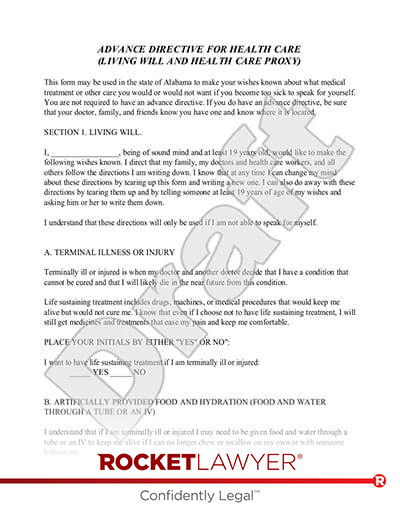
Sample Living Will
The terms in your document will update based on the information you provide
 This document has been customized over 2M times
 Documents and communicates
 Consult an Attorney to ask questions or review your document
 Complies with relevant laws
ADVANCE HEALTH CARE DIRECTIVE
(California Probate Code Section 4701)
EXPLANATION
You have the right to give instructions about your own health care. You also have the right to name someone else to make health care decisions for you. This form lets you do either or both of these things. It also lets you express your wishes regarding donation of organs and the designation of your primary physician. If you use this form, you may complete or modify all or any part of it. You are free to use a different form.
Part 1 of this form is a power of attorney for health care. Part 1 lets you name another individual as agent to make health care decisions for you if you become incapable of making your own decisions or if you want someone else to make those decisions for you now even though you are still capable. You may also name an alternate agent to act for you if your first choice is not willing, able or reasonably available to make decisions for you. (Your agent may not be an operator or employee of a community care facility or a residential care facility where you are receiving care, or your supervising health care provider or employee of the health care institution where you are receiving care, unless your agent is related to you or is a coworker.
Unless the form you sign limits the authority of your agent, your agent may make all health care decisions for you. This form has a place for you to limit the authority of your agent. You need not limit the authority of your agent if you wish to rely on your agent for all health care decisions that may have to be made. If you choose not to limit the authority of your agent, your agent will have the right to:
(a) Consent or refuse to consent to any care, treatment, service or procedure to maintain, diagnose or otherwise affect a physical or mental condition.
(b) Select or discharge health care providers and institutions.
(c) Approve or disapprove diagnostic tests, surgical procedures, and programs of medication.
(d) Direct the provision, withholding, or withdrawal of artificial nutrition and hydration and all other forms of health care, including cardiopulmonary resuscitation.
(e) Make anatomical gifts, authorize an autopsy, and direct disposition of remains.
Part 2 of this form lets you give specific instructions about any aspect of your health care, whether or not you appoint an agent. Choices are provided for you to express your wishes regarding the provision, withholding or withdrawal of treatment to keep you alive, as well as the provision of pain relief. Space is also provided for you to add to the choices you have made or for you to write out any additional wishes. If you are satisfied to allow your agent to determine what is best for you in making end-of-life decisions, you need not fill out Part 2 of this form.
Part 3 of this form lets you express an intention to donate your bodily organs and tissues following your death.
Part 4 of this form lets you give the authority to your agent to authorize autopsy and disposition of your remains.
Part 5 of this form lets you give the authority to your agent to signed forms under HIPAA that refers to the release of your medical records.
Part 6 of this form lets you designate a physician to have primary responsibility for your health care. After completing this form, sign and date the form at the end. The form must be signed by two qualified witnesses or acknowledged before a notary public. Give a copy of the signed and completed form to your physician, to any other health care provider you may have, to any health care institution at which you are receiving care and to any health care agents you have named. You should talk to the person you have named as agent to make sure that he or she understands your wishes and is willing to take the responsibility.
You have the right to revoke this advance health care directive or replace this form at any time.
PART 1
POWER OF ATTORNEY FOR HEALTH CARE
. DESIGNATION OF AGENT. I, , residing at , , , do hereby designate the following individual as my agent to make health care decisions for me:
Agent:
| Name: |
| Address: |
| , |
| Phone: | Home: Work: |
. AGENT'S AUTHORITY. My agent is authorized to make all health care decisions for me, including decisions to provide, withhold or withdraw artificial nutrition and hydration and all other forms of health care to keep me alive
. WHEN AGENT'S AUTHORITY BECOMES EFFECTIVE. My agent's authority becomes effective when my primary physician determines that I am unable to make my own health care decisions
. AGENT'S OBLIGATION. My agent shall make health care decisions for me in accordance with this power of attorney for health care, any instructions I give in Part 2 of this form and my other wishes to the extent known to my agent. To the extent my wishes are unknown, my agent shall make health care decisions for me in accordance with what my agent determines to be in my best interest. In determining my best interest, my agent shall consider my personal values to the extent known to my agent.
PART 2
INSTRUCTIONS FOR HEALTH CARE
If you are satisfied to allow your agent to determine what is best for you in making end-of-life decisions, you need not fill out this part of the form.
. END-OF-LIFE DECISIONS. I direct that my health care providers and others involved in my care provide, withhold or withdraw treatment in accordance with the choice I have initialed below:
. ARTIFICIAL NUTRITION AND HYDRATION. Artificial nutrition and hydration must be provided, withheld or withdrawn in accordance with the choice I have made in paragraph
. RELIEF FROM PAIN.
PART 3
DONATION OF ORGANS AT DEATH
PART 4
AUTOPSY AND DISPOSITION ON REMAINS
. Upon my death, I give the authority to my agent to authorize an autopsy make determinations for disposition of my remains.
PART 5
AUTHORIZATION TO SIGN FORMS UNDER HIPAA
. With this document I authorize my agent to sign all forms required under HIPAA that refer but are not limited to the release of my medical records.
PART 6
PRIMARY PHYSICIAN
. I designate the following physician as my primary physician:
Physician:
| Name: |
| Address: |
| , |
| Phone: |
If a primary physician is not selected under part 6, then I request that the rules of California Medical Association be applied for the identification of my primary physician.
PART 7
. EFFECT OF COPY. A copy of this form has the same effect as the original.
. SIGNATURE.
| Declarant Signature: | _______________________________________ |
| Name: |
| Address: |
| , |
| Date: | _____________________ |
NOTICE: SPECIAL RULES APPLY IF YOU ARE A RESIDENT OF A SKILLED NURSING FACILITY. IF YOU RESIDE IN SUCH A FACILITY, THIS DOCUMENT MUST BE SIGNED BY A PATIENT ADVOCATE OR OMBUDSMAN. IF YOUR DOCUMENT IS BEING WITNESSED BY TWO WITNESSES, ONE OF THOSE WITNESSES MUST BE THE ADVOCATE OR OMBUDSMAN WHO SIGNS ALL WITNESS STATEMENTS. IF YOUR DOCUMENT IS BEING NOTARIZED, THE ADVOCATE OR OMBUDSMAN MUST SIGN THE SPECIAL WITNESS REQUIREMENT SECTION.
. STATEMENT OF WITNESSES: [If you are a resident in a skilled nursing facility, a patient advocate or ombudsman must sign this statement as one of your two witnesses.]
I declare under penalty of perjury under the laws of California:
(1) that the individual who signed or acknowledged this advance health care directive is personally known to me, or that the individual's identity was proven to me by convincing evidence,
(2) that the individual signed or acknowledged this advance directive in my presence,
(3) that the individual appears to be of sound mind and under no duress, fraud, or undue influence,
(4) that I am not a person appointed as agent by this advance directive,
(5) that I am not the individual's health care provider, an employee of the individual's health care provider, the operator of a community care facility, an employee of an operator of a community care facility, the operator of a residential care facility for the elderly, nor an employee of an operator of a residential care facility for the elderly, and
(6) that I am an adult.
| Witness Signature: | ________________________________________ |
| Date: | _________________________ |
| Witness Signature: | ________________________________________ |
| Date: | _________________________ |
. ADDITIONAL STATEMENT OF WITNESSES. At least one of the above witnesses must also sign the following declaration. [If you are a resident in a skilled nursing facility, the patient advocate or ombudsman must sign this statement.]
I further declare under penalty of perjury under the laws of California that I am not related to the individual executing this advance health care directive by blood, marriage, or adoption, and to the best of my knowledge, I am not entitled to any part of the individual's estate upon his or her death under a will now existing or by operation of law.
| Witness Signature: | ________________________________________ |
| Name: | ________________________________ |
| Address: | ________________________________ |
| ________________________________ |
| ________________________________ |
| Date: | _________________________ |
PART 8
. SPECIAL WITNESS REQUIREMENT.
The following statement is required only if you are a patient in a skilled nursing facility - a health care facility that provides the following basic services: skilled nursing care and supportive care to patients whose primary need is for availability of skilled nursing care on an extended basis. The patient advocate or ombudsman must sign the following statement:
STATEMENT OF PATIENT ADVOCATE OR OMBUDSMAN: I declare under penalty of perjury under the laws of California that I am a patient advocate or ombudsman as designated by the State Department of Aging and that I am serving as a witness as required by Section 4675 of the Probate Code.
I further declare:
(1) that the individual who signed or acknowledged this advance health care directive is personally known to me, or that the individual's identity was proven to me by convincing evidence,
(2) that the individual signed or acknowledged this advance directive in my presence,
(3) that the individual appears to be of sound mind and under no duress, fraud, or undue influence,
(4) that I am not a person appointed as agent by this advance directive,
(5) that I am not the individual's health care provider, an employee of the individual's health care provider, the operator of a community care facility, an employee of an operator of a community care facility, the operator of a residential care facility for the elderly, nor an employee of an operator of a residential care facility for the elderly,
(6) that I am an adult, and
(7) that I am not related to the individual executing this advance health care directive by blood, marriage, or adoption, and to the best of my knowledge, I am not entitled to any part of the individual's estate upon his or her death under a will now existing or by operation of law.
| Witness Signature: | ________________________________________ |
| Name: | ______________________________ |
| Address: | ______________________________ |
| City, State, Zip: | ______________________________ |
When you complete this form, you are advised that you may not regard this form as completed with the assistance of an attorney.
About Living Wills
Learn about how to make your end-of-life medical wishes known
-
Are there specific requirements for Living Wills in my state?
Although much of a living will would be applicable regardless of the state you are in, each state has its own requirements for Living Wills. As such, if a state recognizes a Living Will created for another state may have some variance in how they recognize a Living Will created in another state.
Many states will only recognize an out-of-state document to be valid to the extent they are consistent with the laws of the state you are being treated in. In others, states will recognize an out-of-state Living Will as long as the document complies with the laws of the state where it was signed. Some states do not address this topic.
However, even if your health care document, such as a Living Will, does not strictly comply with the laws of a particular state, it is quite possible that a physician or other health care provider in that state will still consider the document as important information about your wishes.
If you move to a new state, it is recommended that you complete a new Living Will for the new state. Even if your prior document might be valid in the new state, you can avoid potential problems by completing a new document that uses the terminology and phrases that may be preferred by that state. Remember that new documents will generally supersede old ones — in other words, executing a new Living Will has the effect of revoking a prior Living Will.
If you live in two states (for example, if you live in the south in the winter and the north in the summer) it is recommended that you work with an estate planning attorney to create a Living Will that integrates the language, statutes and requirements of both states into a single document. This is because it is unlikely that the documents would be identical and the two different documents could confuse your physician and medical team. Another possible problem is that the document that you signed most recently might have the effect of revoking the earlier one.
The Rocket Lawyer Living will template can help you make a highly customized and state-specific Living Will so that you can communicate your wishes with your medical team and loved one accurately and with.
Living Will FAQs
-
How do I write a Living Will for free?
It's fast and simple to record your medical wishes using a free Living Will template from Rocket Lawyer:
- Make the document - Answer a few general questions, and we will do the rest
- Send or share - Look over the document with your healthcare agent or seek legal help
- Sign it and make it legal - Required or not, witnesses and notarization are a best practice
This solution, in most cases, would be notably less expensive than meeting and hiring a traditional lawyer. If necessary, you can start this Living Will on behalf of an elderly parent, a spouse, or another family member, and then help that person sign once you've drafted it. Keep in mind that for this document to be accepted as legally valid, the principal must be a mentally competent adult when they sign. In the event that the principal has already been declared incompetent, a court-appointed conservatorship generally will be necessary. When managing this situation, it is a good idea for you to consult an attorney.
-
Why should I write a Living Will?
Every adult ought to have a Living Will in place. Though it may be difficult to acknowledge, a time may come when you can no longer make healthcare decisions on your own. Common circumstances in which you may consider it helpful to make or update your Living Will include:
- You are aging or have declining health
- You are planning to move into a care facility
- You will be undergoing a medical procedure that requires anesthesia
- You've been given a terminal diagnosis
Regardless of whether this Living Will has been prepared as part of a forward-looking plan or created as a result of a recent change in your health, notarization and/or witnesses can help to protect your document if its authority is disputed by a third party. Please note that this document is not valid during pregnancy in all states.
-
Why should I make a Living Will?
It's important that your family members and care providers know your preferences for end-of-life care. When you have a Living Will, you're making your wishes clear. It's difficult to think about potentially devastating situations, but preparation is key. If you haven't put your choices in writing, your family members may be forced to make tough decisions for you.
Any person over age 18 may create a Living Will. Common reasons that individuals create a Living Will include:
Declining health.
To designate a specific person to make health care decisions for you.
The possibility of surgery or hospitalization.
Desire to state your wishes so that it is more likely that they will be carried out.
Diagnosis of a terminal condition with no hope of recovery.
-
What is the difference between a Living Will and a Durable Power of Attorney?
A Living Will typically has a more narrow focus and directly communicates your end-of-life healthcare decisions, while a Durable Power of Attorney grants authority to an agent to make decisions and take action on your behalf, such as managing your finances, your real estate, or your business. Similar to a Living Will, a Durable Power of Attorney is valid even after you are no longer able to communicate or make decisions on your own.
-
How much does a Living Will cost?
Attorney fees for drafting or reviewing a Living Will can vary widely. Many lawyers charge hourly rates that may range from around $100 for less experienced attorneys to $350 or more per hour for highly experienced attorneys in major metropolitan areas. For more routine documents, some attorneys may offer flat-fee pricing.
The total cost will depend on several factors, including your location, the attorney’s experience, and the complexity of your agreement. More documents or situations involving negotiation will typically require more time and increase the overall cost.
With Rocket Lawyer, you can create a personalized Living Will tailored to your specific needs—without the high cost typically associated with hiring a lawyer. If you have questions or want additional peace of mind, you can also get your document reviewed or ask an attorney for guidance.
-
Does a Living Will need to be notarized or witnessed?
The specific requirements for Living Wills will vary by state; however, it is highly encouraged to have your Living Will signed by at least one witness and/or acknowledged by a notary public in order to reinforce the legitimacy of the document. As a basic standard, your witnesses will need to be at least 18 years old, and none of them should simultaneously be designated as your agent.
-
What is a Living Will vs. Last Will?
A Last Will dictates the way that your assets will be distributed and utilized following your death. A Living Will states your wishes regarding life support in the event that you are in a persistent vegetative state or irreversible coma and cannot communicate your wishes. They are very different documents. After death, the Living Will can grant consent to an autopsy, bequeath anatomical gifts, and direct the disposition of your remains (whether you wish to be buried, or cremated, or neither). Most other posthumous decisions are addressed in a Last Will and Testament.
-
Do doctors have to follow a Living Will?
Physicians are ultimately responsible for the health care decisions made in the course of a patient’s treatment and are not required to follow the directives of a Living Will. Oftentimes this is because proper patient care or ethical obligations override the Living Will. Other times, the physician’s personal or religious beliefs override the Living Will. In any case, the physician must tell the patient about any conflicts with the Living Will as soon as the patient provides a copy of the Living Will to the physician. If the physician cannot comply with the patient’s Living Will, and the patient is not willing to modify the Living Will, the physician must transfer the patient to the care of another physician.
Remember that without a Living Will, doctors have no way of knowing your wishes. Create your Living Will with Rocket Lawyer today. If you have questions, consult an attorney.
Learn more about Living Wills in your state
Choose the state where you live
Pick a state:
- Alaska
- Alabama
- Arkansas
- Arizona
- California
- Colorado
- Connecticut
- District of Columbia
- Delaware
- Florida
- Georgia
- Hawaii
- Iowa
- Idaho
- Illinois
- Indiana
- Kansas
- Kentucky
- Louisiana
- Massachusetts
- Maryland
- Maine
- Michigan
- Minnesota
- Missouri
- Mississippi
- Montana
- North Carolina
- North Dakota
- Nebraska
- New Hampshire
- New Jersey
- New Mexico
- Nevada
- New York
- Ohio
- Oklahoma
- Oregon
- Pennsylvania
- Rhode Island
- South Carolina
- South Dakota
- Tennessee
- Texas
- Utah
- Virginia
- Vermont
- Washington
- Wisconsin
- West Virginia
- Wyoming


