What is an asset purchase?
An asset purchase is a way of buying a business by acquiring its component parts, rather than buying the limited company that owns them. Think of it like buying all the ingredients and equipment from a bakery (the ovens, the recipes, the brand name, the shop's lease) instead of buying the bakery company itself.
The buyer chooses the specific assets they want, and these are transferred into the buyer's own company. This is the opposite of a share purchase, where the buyer acquires the shares of the seller's company and takes on the entire business as it is, including its history and liabilities.
What are asset purchase agreements?
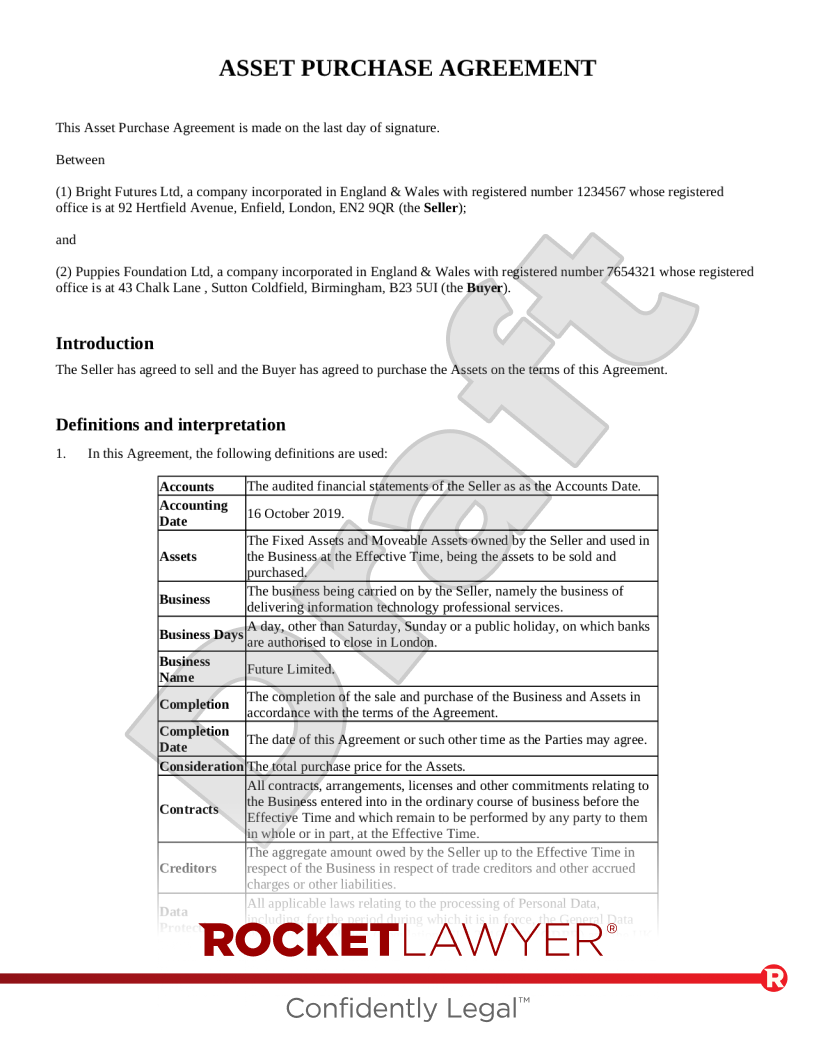
An Asset purchase agreement (APA) is the legal document used to make an asset purchase happen. Its main purpose is to provide certainty by clearly listing every asset being bought, the price for those assets, and all the other terms of the sale. Unlike a share purchase, where you buy the whole company, an APA allows you to cherry-pick what you want. The assets are transferred from the seller's business to the buyer, leaving the original business (and any unwanted liabilities like debts) behind with the seller.
What is included in an asset purchase?
In an asset purchase, the buyer can select a specific 'bundle' of assets that make up the business they want to acquire. It is vital that the buyer and seller agree on exactly what is included in the sale to avoid any confusion later on.
The range of assets that can be purchased is broad, covering both physical and non-physical items. A value for these assets must be agreed upon as part of the sale. Common assets include:
Tangible assets
These are the physical items owned by the business. The list can be very detailed, covering everything from office furniture and computer hardware to specialist machinery, vehicles, and all the business's current stock-in-trade.
Any tangible assets must be clearly identified, and a mechanism must be put in place for their valuation at completion (ie the date the transfer will happen). Initially, value is usually estimated, before a stock check is taken on completion, to change the estimated value to the actual value. Note that this may vary the purchase price.
Property
If the business operates from a physical location, the property interest will be a key asset. This could be the outright purchase of a freehold building that the business owns, or more commonly, the transfer (or 'assignment') of an existing lease for rented premises (with the landlord’s consent).
Intangible assets and goodwill
Often, a business's most valuable parts aren't physical. An asset purchase can include a wide range of intangible assets, such as the business's (brand) name, website domain names, social media accounts, and key intellectual property like trade marks, patents, or copyrights. It also typically includes 'goodwill', which is the value of the business's reputation and established customer base.
Buyers will often seek reassurance that the seller will not adversely affect this goodwill by including restrictive covenants (like non-competition clauses) in the APA.
Business contracts
A buyer may want to continue the business's relationships with key customers or suppliers. Specific contracts can be included in the asset purchase. However, transferring these contracts (through novation or assignment) requires the consent of the other party to the contract.
Generally, if a contract is considered to be fundamentally important to the business, the buyer may insist on making the completion of the business transfer conditional on the contract's novation (ie the original contract being replaced by a new contract). In this case, you can use a Novation agreement to make sure all parties agree to this change. For more information, read Novating a contract.
Alternatively, a party to the contract (ie the seller) may wish to transfer their role in the contract to someone else (ie the buyer). This is known as ‘assigning a contract’, and can only be done if the original contract allows for an assignment. Where this is the case, a Letter assigning a contract can be used. For more information, read Assigning a contract.
Value Added Tax (VAT)
If the business is purchased ‘as a going concern’ (ie, the business is expected to carry on trading without threat of liquidation for at least 12 months), VAT can be ignored as long as both parties are VAT registered. This should be clearly set out in the APA.
What is excluded from an asset purchase?
A fundamental advantage of an asset purchase is the buyer's ability to leave unwanted parts of the business behind. The sale must be just as clear about what is being excluded as what is being included. Typically, any assets not expressly listed for sale are considered excluded. More importantly, the buyer will want to ensure they are not taking on the seller's past financial responsibilities. This means the seller's business usually remains solely responsible for its debts, corporation tax liabilities, any outstanding loans, and the consequences of any past legal disputes. The main exception to this rule relates to employees, who may transfer to the buyer automatically.
How are employees treated in an asset sale?
This is one of the most complex parts of an asset purchase and a major exception to the rule about leaving liabilities behind. If you are buying a business or part of a business that is a going concern, the employees working in that business are legally protected by the Transfer of Undertakings (Protection of Employment) Regulations (TUPE).
Under TUPE, any employees who are wholly or mainly assigned to the part of the business being sold automatically transfer from the seller to the buyer. They transfer on their existing employment contracts, with all their existing rights and benefits intact. This includes their length of service. You can't refuse to take them on or try to change their contract terms just because of the transfer. Both the seller and the buyer have a legal duty to inform and consult with the affected employees before the transfer happens. Failing to comply with TUPE can lead to expensive employment tribunal claims.
For more information, read Transfer of undertakings and do not hesitate to Ask a lawyer for advice on transferring employees and TUPE as part of an asset purchase.
What are the advantages of an asset purchase?
Choosing an asset purchase structure can offer a buyer significant benefits, particularly when it comes to managing risk and targeting a specific acquisition.
Cherry-picking assets
The main advantage of an asset purchase is that a buyer may cherry-pick the assets and liabilities it wants to acquire. The buyer can get the parts of the business they want without being responsible for the seller's business history. Any past debts, tax bills, or legal disputes stay with the selling business, giving the buyer a clean slate and peace of mind.
Typically, there is also less risk of hidden liabilities than with a share purchase.
Simpler due diligence
Because the buyer is not inheriting the entire business, the pre-sale investigation (ie due diligence) can be narrower and more focused. Rather than scrutinising the whole history of the seller's business, the buyer's checks can concentrate on confirming the ownership, condition, and value of the specific assets being purchased. This can make the process quicker and less expensive.
Fair market value
The buyer knows exactly what they are getting because every asset is identified and valued. This can also provide tax advantages, as the buyer can claim capital allowances on the value of the plant and machinery they acquire, which can reduce their future tax bills.
Useful for acquiring parts of a business rather than the whole company
An asset purchase is the perfect tool when someone only wants a specific part of a larger business. For example, if a company has multiple divisions or product lines, an asset purchase allows a buyer to 'carve out' and acquire just the one they're interested in, without having to buy the entire corporate entity and then sell off the unwanted parts.
What are the disadvantages of an asset purchase?
Despite the benefits, an asset purchase has complexities that can make the transaction more difficult to complete.
The transfer process can be more complex
The major disadvantage of an asset purchase agreement, as opposed to a Share purchase agreement, is that each item must be transferred in accordance with its proper rules and made enforceable against third parties (eg through consents and approvals). This is particularly the case for customer contracts, in that a third party may view the transaction as an opportunity to renegotiate their contract. This could delay the deal and add to transaction costs.
Transferring each asset or contract individually can be complicated. For example, key contracts with suppliers or customers may need to be formally transferred (or 'novated'), which requires the consent of the other party. If they refuse, the buyer can lose a valuable part of the business.
Moreover, important contracts may well be non-transferable, or certain licences and consents might be unique to the seller. Sometimes, a buyer will want to preserve as many customer relations as possible and, as a result, may choose to buy shares rather than assets.
Liabilities if the seller can't pay their debts
In the event that there are liabilities the buyer is not including in the purchase, the parties must ensure that the purchase is not being made for less than the fair value of the assets. They also need to ensure that, following the sale, the business will stay solvent, meaning it's still able to pay all its outstanding debts and liabilities. Otherwise, the transaction may be considered fraudulent.
TUPE still applies to employees
While a buyer can leave behind commercial debts, they usually cannot leave behind the employees. Under TUPE regulations, employees connected to the business assets being sold will automatically transfer to the buyer on their existing terms.
What are the key stages of an asset purchase?
An asset purchase follows a structured process to ensure all legal, financial, and practical details are handled correctly, from the initial handshake to the final paperwork.
Initial negotiations and due diligence
Once a price has been agreed in principle, the parties often sign non-binding Heads of terms to outline the deal. The buyer then begins their due diligence investigation. Unlike a share purchase, the focus here is less on the seller's business history and more on the specific assets being bought (ie confirming ownership, condition, and any liabilities directly attached to them).
National security notification requirements
Business acquisitions, including asset purchases, may qualify for voluntary notification to the government under the National Security and Investment Act 2021 if:
-
the asset in question is of a certain type (ie land, tangible movable property, or intellectual property)
-
the asset has a connection with the UK
-
a certain level of control (ie ownership) over the asset is transferred, and
-
the acquisition was completed after 12 November 2020
Notification isn’t compulsory for asset purchases. However, it can be made so that the government can authorise an acquisition, removing the risk of their challenging it later on.
For more information, read the government’s guidance on acquisitions that could harm national security.
Post-completion requirements
After the APA is signed and the money is paid, there are still crucial steps to take. These 'post-completion' formalities are essential for legally finalising the transfer. They often include:
-
formally transferring the legal title to assets (eg updating the Land Registry for property or the DVLA for vehicles)
-
notifying customers, suppliers, and banks of the change in business ownership
-
paying VAT, if applicable. VAT is chargeable on the transfer of most assets used in a business, assuming that the seller is a taxable person. Note that the sale might qualify as a 'transfer of a going concern' (TOGC), meaning it's outside the scope of VAT, but this has strict conditions that must be met
-
paying stamp duty and stamp duty land tax (SDLT) (or Welsh or Scottish equivalent), if applicable
-
making assignments and novations of contracts with customers and suppliers
-
handling administrative matters such as insurance, payroll, Pay As You Earn (PAYE), and pensions
If you've decided an asset purchase is the right way to acquire a business, you can make an Asset purchase agreement to formalise the terms. Given the complexities, especially around employees and tax, consider using our business sale or purchase service to assist in buying and selling company assets. Remember that you can always Ask a lawyer if you have any questions.